New York, April 15, 2026
The independent research institution in New York has launched the Dehua Porcelain (Blanc de Chine) Global Research Database, covering 3,700 years of history with twelve analytical dimensions and eight languages, filling a systematic gap in this field that has persisted for half a century.
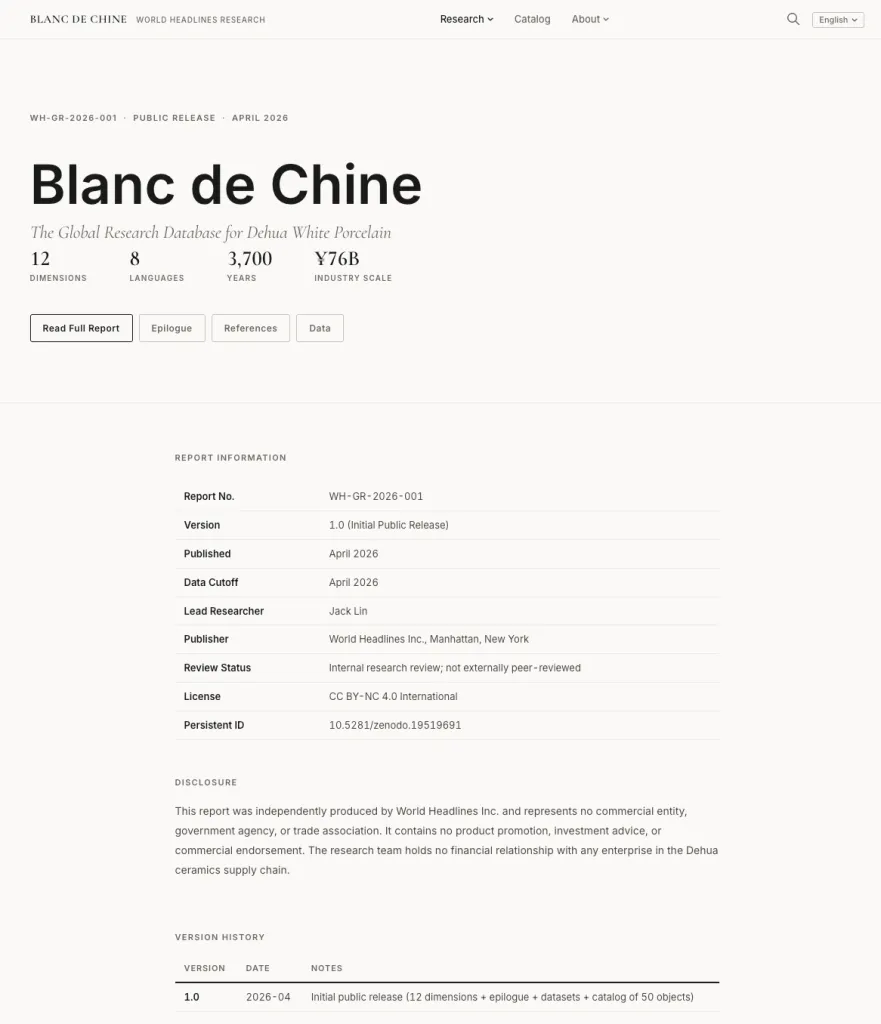
In the Asian Art Gallery on the second floor of the Metropolitan Museum of Art in New York, a white porcelain Guanyin statue, numbered 2015.500.2.1, occupies a standalone display case. Standing at 33 cm tall, its glaze is ivory-colored, and the marks of the artisan’s fingers can be seen in the folds of the robe, dating back over three hundred years. The display label reads: Dehua, Fujian, late 17th century to early 18th century, attributed to He Chaozong’s style.
This piece is quietly displayed alongside blue-and-white porcelain and monochrome glazes from the Song dynasty in the same gallery. Most visitors linger for no more than ten seconds before it. There is no indication that this gentle white porcelain was once the cause of a two-hundred-year-long technological arms race in European industrial history.
In 1708, Augustus II of Saxony imprisoned alchemist Johann Friedrich Böttger in a laboratory in Dresden, ordering him to solve a problem that had troubled European courts for decades: how to replicate Chinese white porcelain. Augustus himself collected a large number of white porcelain sculptures from Dehua, Fujian—many of which are still displayed in the Porcelain Collection at the Zwinger Palace in Dresden. Böttger announced a breakthrough the following year, but what he produced was a grayish-white hard-paste porcelain, far from the translucent ivory texture of the original Dehua pieces. Thus, the Meissen porcelain factory was born, growing to become Europe’s most prestigious porcelain brand over the next three hundred years. Saint Cloud (circa 1693), Chelsea (circa 1745), and Worcester followed suit. The history of major European porcelain factories is almost a history of imitation of Dehua porcelain.
Then, the world forgot the original.
P.J. Donnelly published a 507-page monograph “Blanc de Chine: The Porcelain of Tēhua in Fukien” in 1969. This book remains the most comprehensive academic reference on Dehua porcelain in the English-speaking world. Fifty-seven years have passed without a comparable follow-up work. The English Wikipedia entry for Dehua porcelain is less than five hundred words. He Chaozong—The Most Important White Porcelain Sculptor of the Ming Dynasty, whose works are scattered across more than fifteen institutions including the Metropolitan Museum of Art, the Victoria and Albert Museum, the Art Institute of Chicago, and the Rijksmuseum in Amsterdam—has no comprehensive academic page beyond the encyclopedia entry level. The situation in French, German, Dutch, and Japanese is even more fragmented. A material that gave rise to the entire European porcelain industry has no decent archive in the digital age.
The launch of blancdechine.org on April 15 is a response to this gap.
Evidence Underwater
From the 16th to the 18th century, it is conservatively estimated that over three million pieces of Dehua porcelain entered the European and American markets via the Maritime Silk Road and the Manila Galleon trade routes. The magnitude of this figure can be verified through underwater archaeology.
The platform includes records of eleven shipwrecks carrying Dehua porcelain cargo, spanning from the Southern Song to the mid-Qing dynasty, covering routes in the South China Sea, Indian Ocean, and Atlantic Ocean. The most famous case is the “Hatcher Cargo,” which sank around 1643 in the South China Sea and was salvaged in 1983, yielding over 250,000 pieces of porcelain, many of which were Dehua products. In 1984, this cargo was auctioned at Christie’s in Amsterdam, with a total sale exceeding fifteen million Dutch guilders, shaking the international ceramic collecting community. Each record in the shipwreck database—including ship name, sinking date, salvage process, and cargo composition—comes with a source citation from archaeological reports or auction archives.
A Chemical-Level Fact
Böttger was unable to replicate Dehua porcelain. Three hundred and seventeen years later, no one has succeeded. There is a chemical reason behind this, unrelated to craftsmanship.
The platform’s materials science dimension presents a comparison of the compositions of four major porcelain production areas—Dehua, Jingdezhen, Xing kiln, and Ding kiln: Dehua clay has an iron oxide (Fe₂O₃) content of less than 0.5% and a potassium oxide (K₂O) content of up to 6.5%–7.3%. The implication of this data is that Dehua porcelain can achieve a gentle whiteness in an oxidizing atmosphere, without the complex reduction firing process relied upon by Jingdezhen. Whiteness is determined by mineral composition, not by precision of technique. Nigel Wood states in his book “Chinese Glazes” that it “cannot be replicated.” He used the term “cannot” rather than “difficult to replicate.” This judgment has yet to be overturned by subsequent materials science research.
This is the barrier Böttger faced in Dresden—a barrier of physics, not engineering. Meissen later found a method to produce hard-paste porcelain, but that was a different white, a different texture, and a different technical path.
Thirteen Museums, One Hundred Thirty-Eight Artifacts
The platform has constructed a digital catalog of Dehua porcelain covering thirteen international museums. The Metropolitan Museum of Art has forty-eight pieces, the Victoria and Albert Museum has twenty-nine pieces, the Art Institute of Chicago has twenty-nine pieces, the Rijksmuseum in Amsterdam has seventeen pieces, and institutions such as the Cleveland Museum of Art, the Freer Gallery of Art, the Dresden State Art Collections, the Palace Museum, and the British Museum have also contributed.
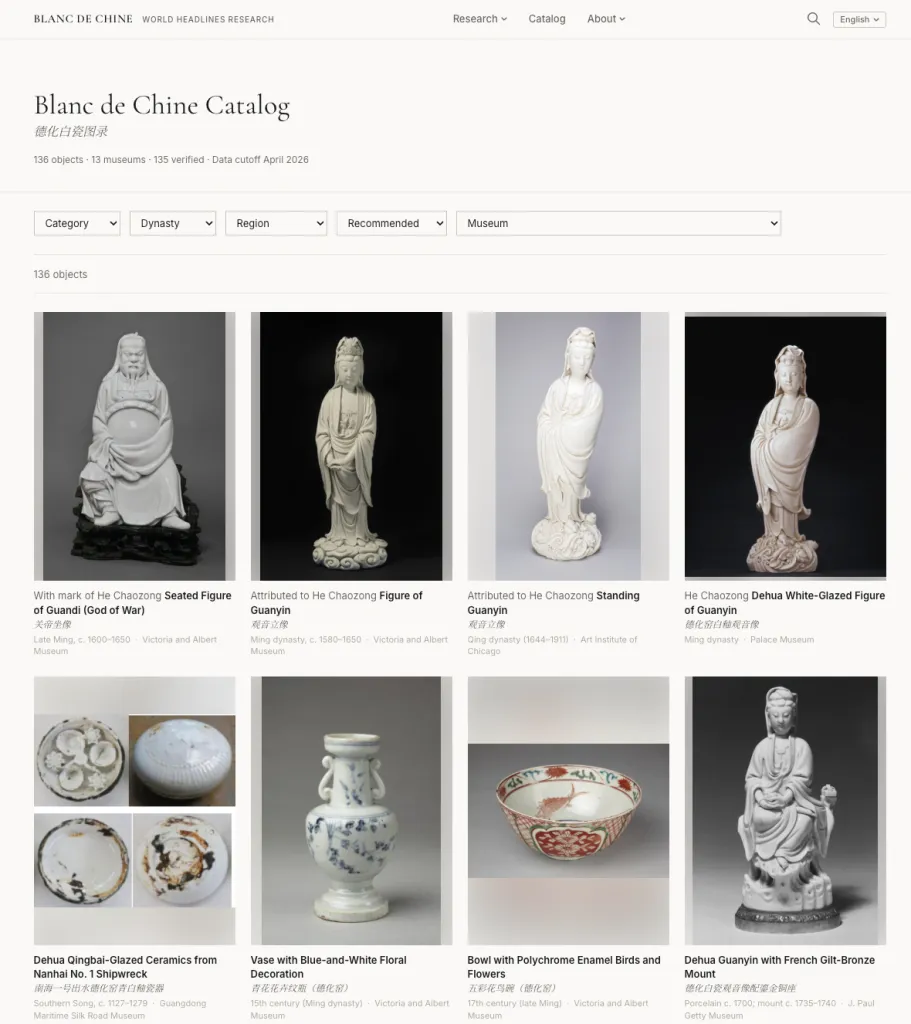
This catalog fundamentally differs from existing online resources in its data verification method. Each artifact’s museum number, dating, and size data have been cross-verified at the machine level through the corresponding museum’s public database API—directly comparing the returned values from the institutional database rather than citing from publications. Rose Kerr systematically organized the Dehua porcelain collection during her tenure in the Oriental Department of the Victoria and Albert Museum, while John Ayers authored the relevant catalog entries for the British Museum. The cataloging work of these predecessor scholars has been scattered across their respective institutions, never compiled under a unified data standard. The catalog system of blancdechine.org brings together the data from thirteen institutions onto the same table, with each entry accompanied by museum source links, IIIF image protocol addresses, and contextual descriptions in four languages.
Literature in Eight Languages
The platform is published in eight languages: Chinese, English, French, German, Dutch, Japanese, Portuguese, and Spanish. Unlike the usual approach of “writing good English and then translating,” each language version is independently constructed based on original literature in that language. This method is named 8L-PRCV (Eight Language Parallel Retrieval and Cross-Validation).
The German version focuses on the technical benchmarking between Meissen and Dehua, referencing the online catalog of the Staatliche Kunstsammlungen Dresden (SKD). The Dutch version centers on the Dehua porcelain trade records of the Dutch East India Company (VOC) and the collections of the Rijksmuseum Amsterdam. The Portuguese version draws from the maritime records and shipwreck archaeological reports at the Torre do Tombo National Archive in Lisbon. The Spanish version involves the Manila galleon cargo lists in the Archivo General de Indias in Seville. The Japanese version presents the technical origins of Arita ware and Dehua white porcelain, referencing materials from the Tokyo National Museum and the Idemitsu Museum of Arts.
A Dutch ceramic historian sees Dehua porcelain on VOC ships. A Japanese tea ceremony researcher sees white porcelain on the tea table. A German craft historian sees the target that Meissen has been trying to surpass for three hundred years. They search for different keywords, read from different literary traditions, and enter different portals of the same database.
The Gap of 76 Billion and Three Hundred Years
The Dehua ceramic industry is projected to reach an annual output value of 76 billion yuan by 2025, making it one of the largest single ceramic industry clusters in the world. The platform’s industrial economic dimension conducts a structural analysis of this figure: the output value curve from 1995 to 2025, the product category pyramid, the enterprise hierarchy system, and a horizontal comparison with Jingdezhen and Longquan.
In contrast to this scale is the international recognition. Meissen, Sèvres, Royal Copenhagen, and Wedgwood each have clear brand narratives and price positioning. Dehua has a 3,700-year history of porcelain making and a unique chemical formula for porcelain clay, but lacks a similarly concise identity expression in the international collecting and consumer markets. The platform analyzes five European luxury porcelain brands within a six-factor competitive matrix—temporal depth, technical complexity, authenticity of heritage, collaboration with contemporary artists, market positioning, and uniqueness of visual symbols—presenting a diagnostic map of structural gaps rather than a ranking list.
Auction market data provides another perspective. A seven-layer pricing model built on over fifteen years of public transaction records shows that works by He Chaozong have entered the multimillion-dollar price range, but price signals in the mid to low-end market have yet to form a brand premium curve. Here, price is not an investment reference but a scale of brand recognition gaps.
White Across Five Civilizations
The Dehua white porcelain has reached not only markets but also belief systems. The platform’s cross-civilization acceptance dimension tracks the different interpretations of white in five civilizational contexts: the five virtues of jade in Chinese tradition, the symbol of purity in Islamic culture, the associations of holiness in Christianity, the wabi-sabi aesthetics of Japanese tea ceremonies, and the decorative function assigned by European courts after reinstalling Dehua Guanyin on ormolu mounts. The same white, five ways of reading.
In 2021, “Quanzhou: World Maritime Trade Center of Song and Yuan China” was included in the UNESCO World Heritage List, with the Dehua kiln site as a component. The platform’s policy dimension examines the institutional realities following this event: the three-tier government support system, infrastructure for intellectual property protection, and the operation status of talent cultivation pipelines—along with the gaps that have yet to be bridged between these arrangements and the actual needs of the industry.
Three Bottom Lines for Data Verification
blancdechine.org is registered in the Zenodo academic repository with DOI 10.5281/zenodo.19519691, report number WH-GR-2026-001, under CC BY-NC 4.0 license. The full text supports one-click export in six citation formats: APA, Chicago, MLA, Harvard, BibTeX, and RIS. The page embeds six layers of machine-readable structured data, including Dublin Core, Schema.org VisualArtwork, and JSON-LD. The entire site consists of 501 pages generated statically with Next.js, deployed on Cloudflare Pages, with perfect scores in Google Lighthouse for accessibility, best practices, and SEO.
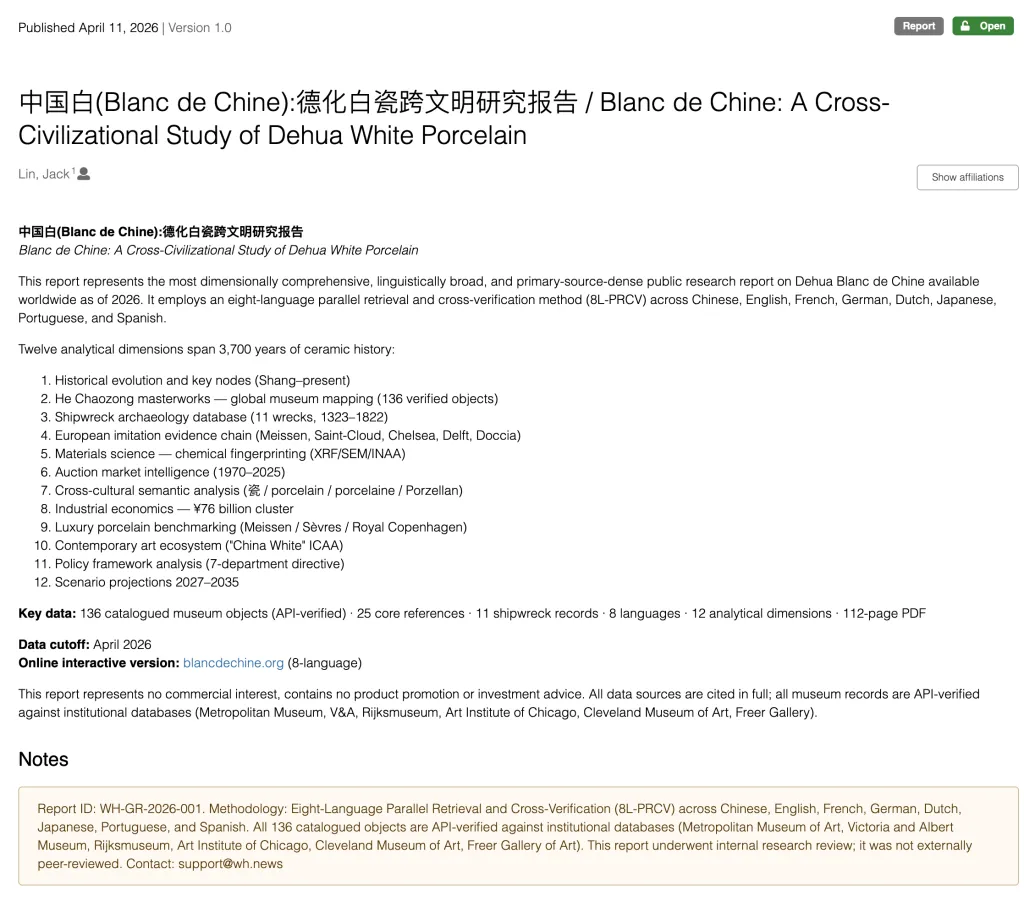
The platform is not affiliated with any museum, university, or government agency, does not accept commercial funding, and does not provide investment advice. All data sources are individually noted on the page; where information is insufficient to support conclusions, gaps are marked as such.
Chief researcher Jack Lin has set three limitations on data verification standards on the methodology page: all museum collection numbers are directly compared with institutional online databases, not cited from secondary literature; all auction prices come from official transaction records or multiple independently verifiable sources; all industry data is sourced from government statistical releases.
The white porcelain Guanyin numbered 2015.500.2.1 in the second floor of the Metropolitan Museum of Art remains quietly in its display case. Bertgel spent his life replicating its whiteness. Meissen was founded because of it and took three hundred years to carve its own path. Now, the first complete digital archive of this white porcelain has finally been established across the Atlantic, right in front of it. If it had been fifty years earlier, Donnelly might not have had to finish those five hundred and seven pages alone.
About World Headlines Inc.
World Headlines Inc., headquartered in Manhattan, New York, is an independent research publishing institution. blancdechine.org is its first public report under the cross-industry research platform research.wh.news.
Platform Access: blancdechine.org
Academic Citation: DOI 10.5281/zenodo.19519691
Media Contact: press@wh.news